This Sunday, Saint Francis
Parish and Outreach keeps its patronal feast, and this year the day carries
extra weight. Eight hundred years ago, at sunset on October 3, 1226, Francis of
Assisi died at the Porziuncola, a tiny chapel on the plain below his hometown.
He had asked to be laid on the bare ground, owning nothing, so that he could
die the way he had tried to live. Franciscans call that night the Transitus,
the crossing over.
I want to tell you why I think
this Sunday's Gospel belongs to him.
The stone
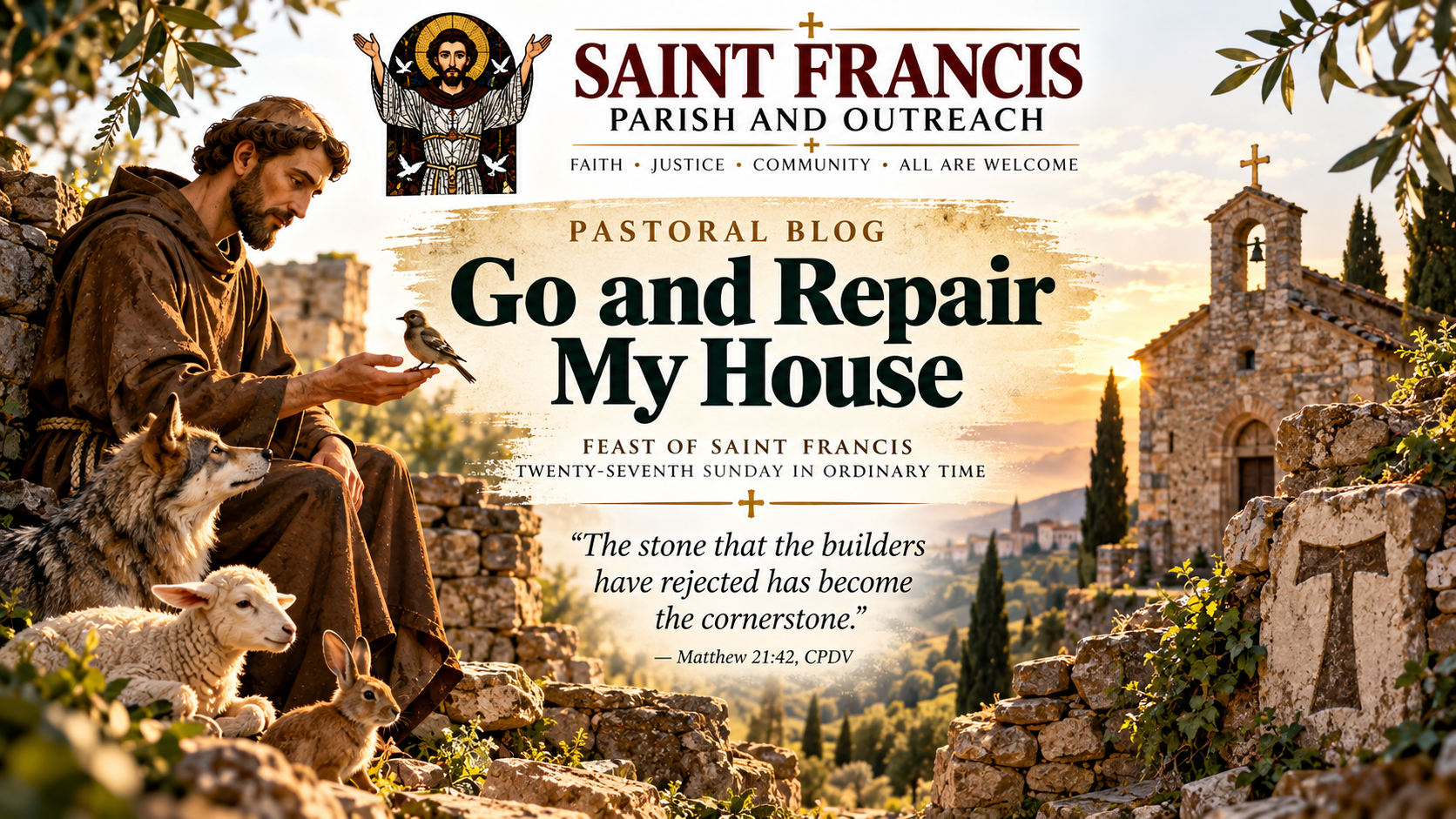
that the builders have rejected has become the cornerstone. (Matthew 21:42, CPDV)
The
Stone the Builders Set Aside
Francis was exactly that kind of
stone. He was born to a wealthy cloth merchant and expected to build the family
business. Instead he knelt in a crumbling country chapel called San Damiano,
and the old painted cross above the altar seemed to speak to him: Francis, go
and repair my house, which, as you see, is falling into ruin.
He took it literally. He
gathered stones and began to repair a chapel that almost nobody else thought
worth saving. His father, furious, disinherited him. It took Francis years to
understand that Christ meant something larger than a building, a Church whose
faith had gone slack and whose people had grown comfortable. But he began where
he was, with the stone in front of him.
Eight centuries later, we are
still standing on what he laid.
Where
Is the Fruit?
Isaiah's song of the vineyard
and the parable Jesus tells in answer to it ask one question: where is the
fruit? Isaiah says God looked for justice and found an outcry. Jesus says the
kingdom will be given to a people who produce its fruits. Notice the test. It
is not size, or standing, or who holds the deed to the vineyard. It is fruit.
That is a freeing standard for a
small house like ours. We are a parish of twenty-three years in Augusta,
Georgia, with a cross on the wall, an open door, and a great many stones still
waiting to be carried. I do not know how many people will walk in this Sunday.
I do know that Francis never asked whether a ruin was large enough to be worth
repairing. He picked up the stone in front of him and carried it.
Be
Anxious About Nothing
Paul's word to the Philippians
in this Sunday's second reading is Francis's whole way of life in a few lines.
Be anxious about nothing, he writes, and whatever is just, whatever is holy,
whatever is worthy to be loved: meditate on these, and do them. Francis did
them. He greeted everyone he met with the words we still use to close our
letters, Pax et Bonum, peace and good. The old stories say he preached to the
birds and made peace with a wolf. Whatever you make of the details, the pattern
is plain. He treated every creature as a brother or a sister, and the world
around him slowly began to behave as if it were true.
Come
This Sunday
Mass is at 3:00 PM Eastern on
Sunday, October 4, at 557 Greene Street in Augusta, and live online for
everyone who cannot be with us in person. As I announced, anyone who attends
Mass at Saint Francis Parish and Outreach that day will receive a plenary indulgence
in honor of the eight hundredth anniversary of the Transitus.
Immediately after Mass we will
hold our Blessing of the Pets. Bring your animals, or a photo if they cannot
come, and we will bless them in the name of the man who called the sun his
brother and the moon his sister.
If you have been waiting for a
sign that a house this small is worth repairing, here is the oldest one we
have: the stone the builders rejected has become the cornerstone. Come and help
carry a few more.
Pax
et Bonum, Bishop Greer |