Today the President announced that the execution of
Nidal Hasan will not be livestreamed. A week earlier he had said he
“absolutely” supported the idea. Hasan, who killed thirteen people at Fort Hood
in 2009, will still be put to death by firing squad on December 3, “as
scheduled,” and the immediate families of the victims will be able to watch.
Reporters note that a broadcast would have been the first public execution in
this country since 1936.
I am glad the cameras are gone. But I want us to be
honest about the reason we were given. The President wrote that streaming
“might have been a strong deterrent,” and that many people “would rather not
watch him die.” That is a statement about our stomachs. It says nothing about
our souls, and it leaves standing the thing that matters most: the state is
still choosing to kill a human being, and the Defense Secretary who proposed
the broadcast said its purpose was deterrence.
This Sunday’s Gospel gives us the right question to ask
about all of it.
The Coin
The Pharisees and the Herodians, who were no natural
allies, come together to trap Jesus in public. Is it lawful to pay the census
tax to Caesar, or not? Either answer will cost him. Jesus does not argue in the
abstract. He makes them produce the evidence:
“Show me the coin of the census tax.” And they offered
him a denarius. And Jesus said to them, “Whose image is this, and whose
inscription?” They said to him, “Caesar’s.” Then he said to them, “Then render
to Caesar what is of Caesar; and to God what is of God.” (Matthew 22:19–21, CPDV)
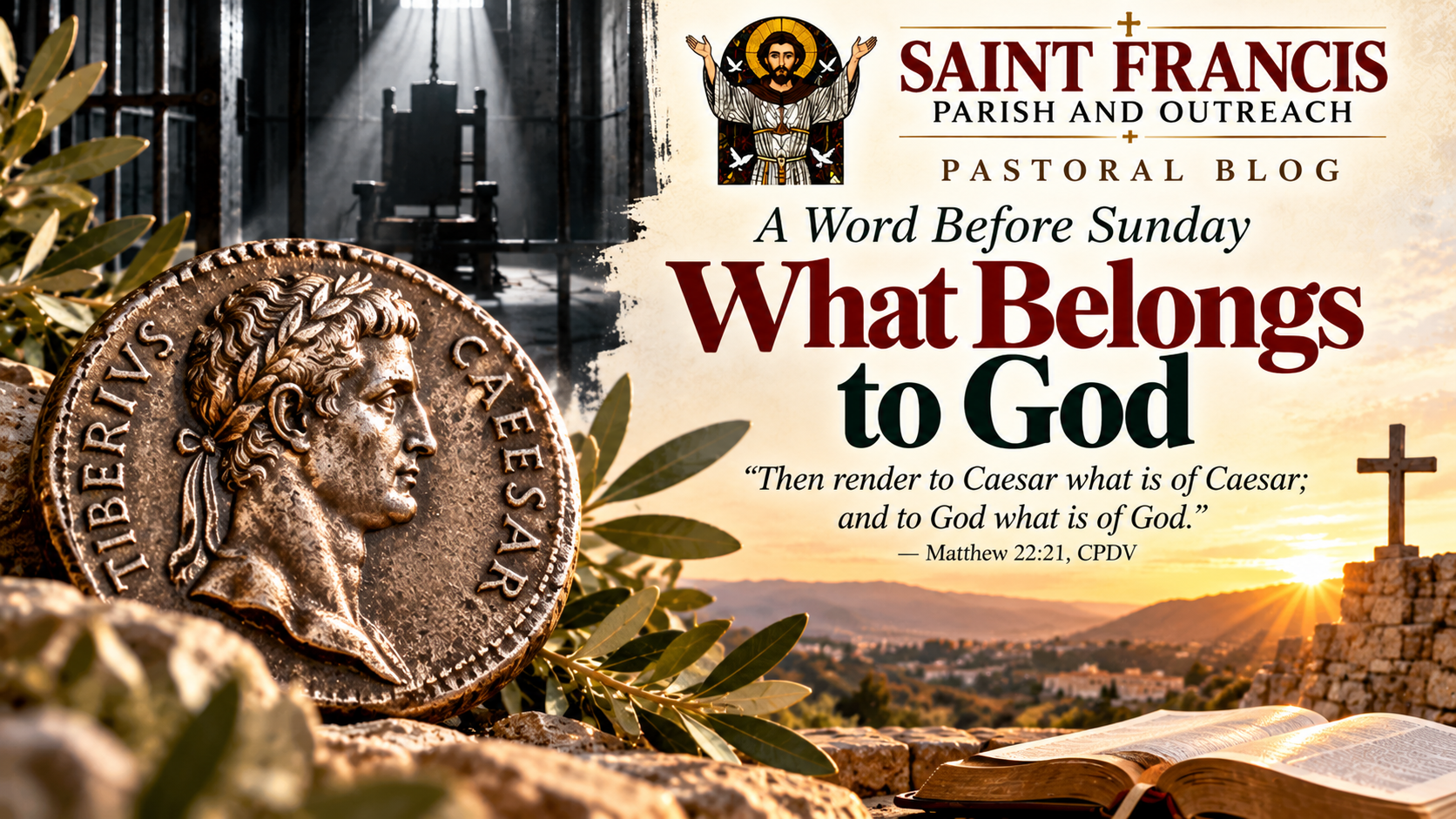
The coin most often connected with this scene is a
denarius of Tiberius, whose inscription calls him the son of the divine
Augustus. Scholars cannot be certain it was that very coin, but the point does
not depend on it. A coin carries a face and a claim. Caesar may have what bears
his face.
So what bears God’s?
“And God created man to his own image; to the image of
God he created him; male and female, he created them.” (Genesis 1:27, CPDV)
Every person. A government can mint coins. It cannot
mint people, and it does not own what God has stamped. There are two things
Caesar keeps reaching for that were never his: a person’s life, and a person’s
voice. I want to say a word about each.
A Life
Their names were Michael Grant Cahill, John P. Gaffaney,
Juanita L. Warman, Libardo Eduardo Caraveo, Russell Gilbert Seager, Justin
Michael DeCrow, Frederick Greene, Amy Sue Krueger, Kham See Xiong, Michael S.
Pearson, Jason Dean Hunt, Francheska Velez, and Aaron Thomas Nemelka. Thirteen
people were killed at Fort Hood. Nothing I say here makes that crime smaller,
and nothing in the Gospel asks the families who loved them to forgive on a
schedule. They are owed our prayers, our honesty, and a justice that does not
depend on another death.
The Roman Catholic Catechism, since 2018, teaches in
paragraph 2267 that the death penalty “is inadmissible because it is an attack
on the inviolability and dignity of the person,” and that the Church works for
its abolition around the world. That is our conviction too. Scripture has been
saying it from the first murder. When Cain kills his brother, God does not
answer with a firing squad. The Lord places a seal upon Cain “so that anyone
who found him would not put him to death” (Genesis 4:15, CPDV). The first
killer in the Bible is protected, not because he earned it, but because God
refused to let vengeance be the last word. And through Ezekiel the Lord says:
“I do not desire the death of the impious, but that the impious should convert
from his way and live” (Ezekiel 33:11, CPDV).
Some will answer with Genesis 9:6, “Whoever will shed
human blood, his blood will be poured out.” Read the rest of the verse: “For
man was indeed made to the image of God.” That is why a life is precious. It is
also why the life in the cell is precious. The image does not wear off.
I will add one more thing, and it concerns the plan
itself. The stated purpose of showing the execution to the public was
deterrence. A killing designed to be watched, so that others will be
frightened, is theater. A people that learns to enjoy theater like that does
not become safer. It becomes harder.
A Voice
The other thing Caesar keeps reaching for is the ballot,
and the Bible knows exactly how that story goes. King Ahab wants the vineyard
of a man named Naboth, and Naboth will not sell his inheritance. So the queen
does what powerful people have always done when the law is in the way: she uses
the law. She sends letters. She proclaims a fast. She seats Naboth in a place
of honor and brings in two witnesses who say, “Naboth has blasphemed God and
king.” Everything is done in proper form. Naboth is stoned, and Ahab takes the
vineyard (1 Kings 21, CPDV). Every form was followed: the fast, the trial, the
witnesses, the verdict. Only the truth was missing.
The prophet Amos describes the same pattern: those
“accepting bribes, and depriving the poor at the gate” (Amos 5:12, CPDV). The
gate was where the town made its decisions. Being shut out of the gate was
being shut out of a say. And Proverbs gives the instruction to the rest of us:
“Open your mouth for the mute… Open your mouth, declare what is just” (Proverbs
31:8–9, CPDV).
Here is what the record shows today, and I am using
reporting and court rulings, not rumor.
The Brennan Center’s October roundup counts at least 11
states that enacted 14 restrictive voting laws in 2026, and 22 states with 47
such laws since the 2024 election. Several states now require documentary proof
of citizenship to register. In Utah and South Dakota, a person who cannot
produce a passport or birth certificate may vote only in federal elections.
Seven states are using flawed federal data for voter list maintenance, which
the Brennan Center warns could remove eligible citizens, including naturalized
citizens whose records are out of date. And the Justice Department has demanded
voter rolls, with sensitive personal information, from nearly every state.
On April 29, in Louisiana v. Callais, the Supreme
Court held in an opinion by Justice Alito that Section 2 of the Voting Rights
Act is violated only where the evidence supports a strong inference that a
state drew districts with the intent to give minority voters less opportunity
because of their race. Since then, Louisiana, Tennessee, and Alabama have
redrawn their maps, and reporting says the new lines split Black voters into
Republican-leaning districts. Civil rights experts warn that decades of
progress in electing Black representatives are at risk.
On October 9, a federal judge, Sparkle Sooknanan, ruled
that the Justice Department unlawfully sought state voter rolls to check
against an immigration database, writing that the policy “represents the
federal government’s attempt to decide who gets to vote.” And today, the
department sued California over mail ballots, asking a court to make the state
set aside ballots from people on a list of “likely” non-citizens. The
department says it is not seeking to cancel votes. California officials call
the demand legally baseless.
I will not tell you whom to vote for. This parish does
not endorse candidates, and I never will. I will tell you that in a democracy
the people choose the rulers, and the moment the rulers begin choosing the
people, something has been taken that was never Caesar’s to take.
The Men at the Door
There is one more piece of this, and it is the one meant
to be felt rather than seen. A person does not have to be turned away from the
polls to be kept from them. They only have to be afraid.
In February, a Homeland Security official said, “There
will be no ICE presence at polling locations.” On September 1, the Secretary of
Homeland Security said ICE could be at polling places if there is a threat to
the site or if agents are serving a warrant. A department spokesperson says ICE
is “not planning operations targeting polling locations,” but that is a long
way from the first assurance. Asked whether he would send ICE and the National
Guard to voting locations, the President said he would “do anything necessary
to make sure we have honest elections,” as compiled by the group Democracy
Forward. That group also reports that the Justice Department plans to send
1,000 federal monitors to the general election, compared with 289 in the 2022
midterms.
A federal statute, 18 U.S.C. § 592, bars “troops or
armed men” at polling places, with one narrow exception: to repel armed enemies
of the United States. On September 10, the city of Denver, together with civil
rights groups including the League of United Latin American Citizens, Common
Cause, and UnidosUS, sued the Department of Homeland Security, arguing that its
policy violates that law. Seven states, California, Connecticut, Maryland, New
Mexico, Oregon, Rhode Island, and Virginia, have passed laws keeping federal
agents away from polling places. Neither Georgia nor South Carolina is on that
list.
I do not know how many armed agents will stand near a
polling place on November 3. I know what the possibility is for. It is for the
grandmother who was born in another country and has voted in every election for
thirty years and will now wonder whether it is safe. It is for the young man
whose papers are in order and whose cousin’s are not. A threat does not have to
be carried out to do its work.
Isaiah says to Cyrus, the foreign king God used to free
a captive people: “I am the Lord, and there is no one else… I girded you, and
you have not known me.” Rulers are girded by Someone else, and they answer to
Someone else. Power is on loan.
What We Owe
Jesus does not tell us to withdraw from Caesar. He tells
us to give Caesar what is his and to keep giving God what is God’s. Here is
what that can look like this week.
If you are registered, vote. In Georgia, early voting
began on October 13, and Election Day is November 3. The deadline to register
in Georgia was October 5 and in South Carolina October 4, but you can confirm
your status and precinct on Georgia’s My Voter Page at mvp.sos.ga.gov or, in
South Carolina, at scVOTES.gov. In Georgia, the deadline to request an absentee
ballot is October 23.
Know your rights. The nonpartisan Election Protection hotline, run by the
Lawyers’ Committee for Civil Rights Under Law, is 866-OUR-VOTE, or
866-687-8683. If you see or experience intimidation, call.
Go with someone. Offer a ride. Walk with an elderly neighbor, a new
citizen, or anyone who is afraid. Your presence is a statement that this is a
place where people vote.
Write to your members of Congress. Ask them to end the
federal and military death penalty, to oppose any public spectacle of
execution, and to protect access to the ballot and the Voting Rights Act.
Pray. Pray by name for the thirteen, for their families, and
for the man who will die in December. Our Mass intention remains an end to war,
violence, and fascism, and everything in this post belongs inside that prayer.
A Word About Sunday
Come to Mass this Sunday, October 18, at 3:00 PM at 557
Greene Street, or join us online. We will hear a question that is two thousand
years old and has never been more current: whose image is this? If you have
been told that a government, a court, or a crowd gets to decide whether your
life or your voice counts, come hear the other answer. You bear a face that was
not minted by any Caesar. Pax et Bonum, Bishop Greer
|