This Sunday, November 1, we keep two days at one Mass.
All Saints is the day itself, and All Souls, which falls on Monday this year,
joins it. The readings are the ones the Church gives us for All Saints, and the
Gospel is the Beatitudes. I want to say what these days mean, why the
Beatitudes come first for us, and why I hope to see you at the table.
What All Saints Means
All Saints honors every holy person who has gone before
us, the famous and the forgotten. It is not only for the people with statues
and feast days. The Book of Revelation gives the picture:
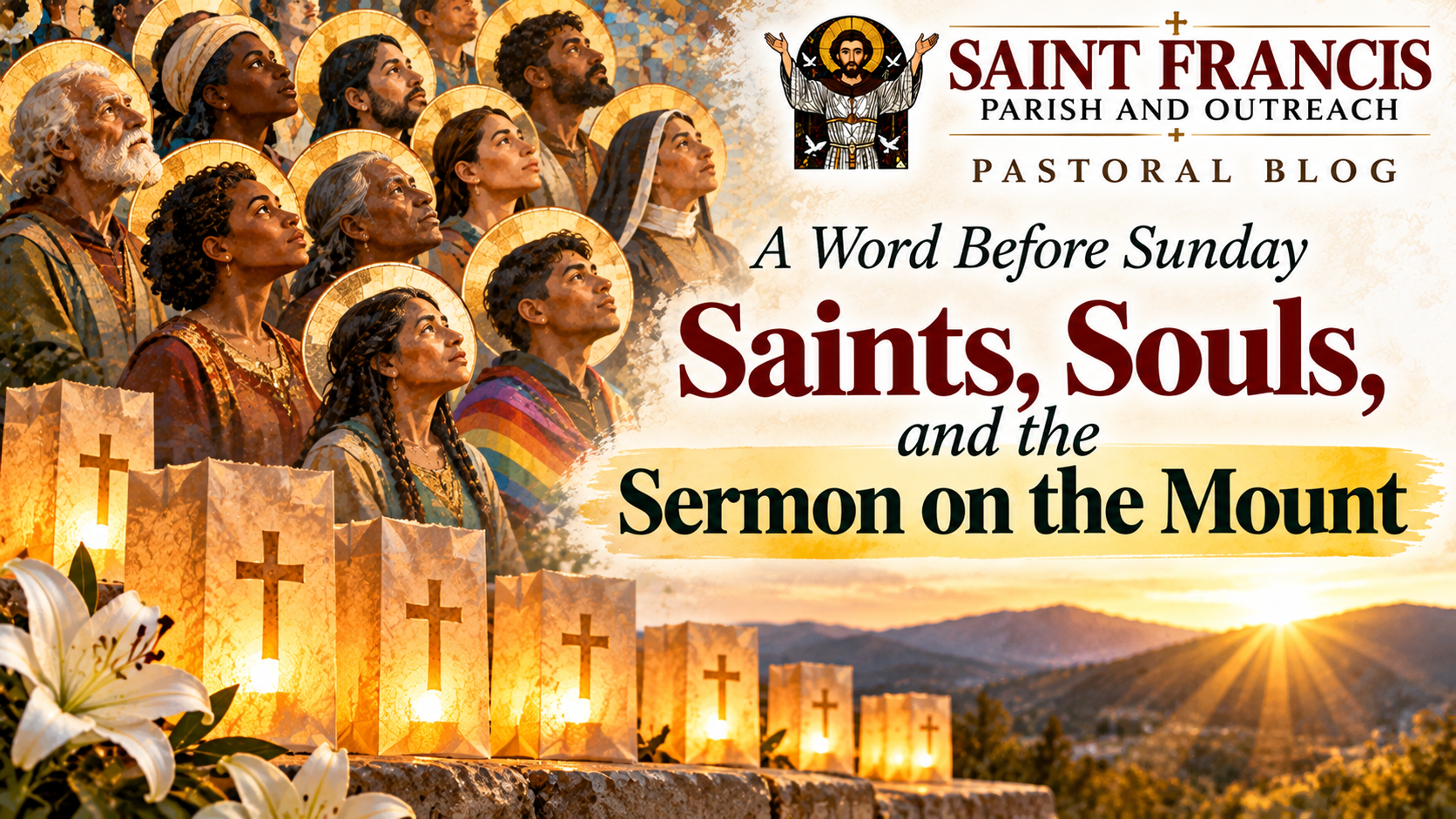
“I saw a great crowd, which no one could number, from
all the nations and tribes and peoples and languages, standing before the
throne and in sight of the Lamb.”
(Revelation 7:9, CPDV)
A crowd no one could number. That includes your
grandmother who prayed the rosary at the kitchen table, the neighbor who
quietly paid someone’s bills, the stranger who stopped for a person on the
roadside. The Church has honored the martyrs and saints together since the
early centuries, and the feast came to be kept on November 1 in the West after
Pope Gregory III dedicated a chapel in Saint Peter’s to all the saints in the
eighth century. Saint John tells us who we are while we wait:
“See what kind of love the Father has given to us, that
we would be called, and would become, the sons of God.” (1 John 3:1, CPDV)
Holiness is not a prize for a few. It is what God is
doing in ordinary people who say yes.
What All Souls Means
All Souls is the day we pray for the faithful departed,
our own dead, by name. It was set on November 2 by Abbot Odilo of Cluny in the
late tenth century. The idea is simple and tender. Love does not stop at the
grave, and neither does prayer. We hold up the ones we miss, and we trust them
to God’s mercy. Because November 2 is a Monday this year, we combine the two
days into one celebration on Sunday, so that the whole parish can gather. If
you would like someone remembered, bring their name to Mass, or send it to us
through our book of intentions or the parish website.
The Gospel Gives Us the Map
If the saints are the crowd, the Beatitudes are the road
they walked. Jesus climbs the mountain, sits down, and says:
“Blessed are the poor in spirit, for theirs is the
kingdom of heaven. Blessed are the meek, for they shall possess the earth.
Blessed are those who mourn, for they shall be consoled.” (Matthew 5:3-5, CPDV)
He goes on: those who hunger and thirst for justice, the
merciful, the pure in heart, the peacemakers, those persecuted for the sake of
justice. Look at who he blesses. Not the powerful, the certain, or the
comfortable. He blesses the people the world walks past. A saint, then, is not
someone who escaped the hard parts of life. A saint is someone who let these
words shape how they met the hard parts.
Why the Beatitudes Come
First
Some people ask why we put the Beatitudes ahead of a
line from Saint Paul or a verse from the Old Testament, especially when those
verses are quoted at us to condemn someone. Let me answer plainly, and let me
say first that we are not throwing anything away. The whole Bible is Scripture,
and we read all of it. But we do not read it flat, as if every verse stood at
the same height. We read it through Christ.
Jesus is the one who fulfills the law and the prophets,
and he is the one who tells us how to read them. He says:
“Do not think that I have come to loosen the law or the
prophets. I have not come to loosen, but to fulfill.” (Matthew 5:17, CPDV)
And when he is asked for the greatest commandment, he
answers with love of God and love of neighbor, and then says, “On these two
commandments the entire law depends, and also the prophets” (Matthew 22:40,
CPDV). The law and the prophets hang on love. That is his rule for interpreting
them.
Here is the part that matters most. Paul agrees with
him. Paul does not stand beside Jesus as a rival teacher. He says, “the entire
law is fulfilled by one word: ‘You shall love your neighbor as yourself’”
(Galatians 5:14, CPDV). And to the Romans: “The love of neighbor does no harm.
Therefore, love is the plenitude of the law” (Romans 13:10, CPDV). So when a
verse is waved at us to justify contempt for a neighbor, to shut a door, or to
silence a person, we ask Jesus’s question and Paul’s question: does this do
harm to the neighbor, or does it fulfill love? If it leaves us less merciful,
less peaceful, and less just, we have misread it, whatever chapter it came
from.
That is why the Beatitudes come first. They are the
plainest description in all of Scripture of what a life in Christ looks like,
and everything else is read in their light.
Why I Hope You Will Come to
Mass
I will say this as your pastor, and I mean it kindly. We
want to see you at Mass every week. It is our great desire, and not because a
number needs to go up. The Beatitudes cannot be lived alone. Nobody becomes
merciful, a peacemaker, or hungry for justice by themselves in a quiet corner.
We learn it among people, and we are held up by one another.
Sunday is where that happens. We hear the Word together.
We pray for the living and the dead together. We come to the table together,
and we are sent out to do the work. Revelation shows the saints as a crowd, and
not as a row of individuals. When you are missing, the crowd is smaller, and it
feels it.
If you have been away, for a month or for years, come
back. There is no test at the door and no questions at the table. Bring a
friend, a neighbor, or a family member who has not been in a long time. We
would love to meet them.
A Word About Sunday
Join us this Sunday, November 1, at 3:00 PM at 557
Greene Street, or online. We will keep the feast of all the saints, pray for
our beloved dead, and hear Jesus bless the poor, the meek, and the peacemakers.
Come as you are. The crowd has room.
Pax et Bonum, Bishop Greer |