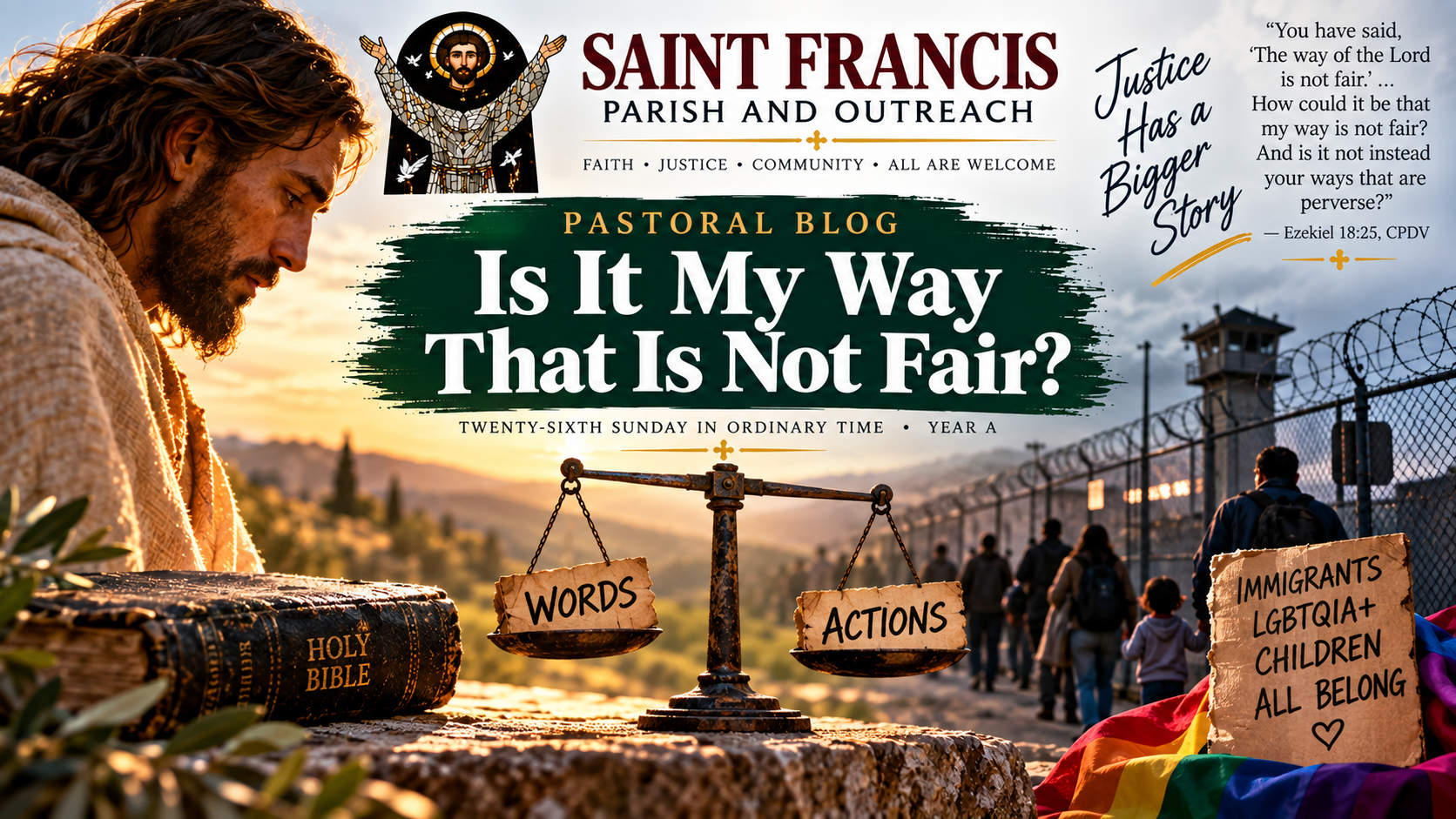
This Sunday's first reading opens with God answering an accusation. The house of Israel has apparently been saying, out loud, that God's way is not fair. And God's response is not defensive. It is a direct question, thrown right back: how could it be that my way is not fair? Is it not instead your ways that are perverse?
I want to sit with that reversal today, because I think it names something happening right now, in this country, with startling precision.
You have said, ‘The way of the Lord is not fair.’ Therefore, listen, O house of Israel. How could it be that my way is not fair? And is it not instead your ways that are perverse? (Ezekiel 18:25, CPDV)
Who Is Actually Claiming Fairness
Right now, federal immigration enforcement is reportedly exploring mobile detention facilities. Immigrants with final deportation orders have been disappearing from ICE's own detainee locator system, meaning families cannot even find out where their loved ones are. A man died in a crash while fleeing an ICE encounter in Michigan this week. Families of people killed in ICE custody have described the pattern to lawmakers using the words dual assassinations. And reporting this month has specifically named children as a next target of enforcement.
At the same time, the current administration has moved to ban transgender individuals from military service entirely, and a Justice Department report earlier this year characterized recognition of transgender people as evidence of, in its own words, radical efforts to punish Christians. Let that framing sit for a moment. Banning trans people from serving their country is described as defending Christians. Denying someone their name, their medical care, their basic recognition is called protecting the faith. Public research this year found that a majority of Americans who hold favorable views of Christian Nationalism also believe immigrants are, in their words, invading our country and replacing our cultural and ethnic background, and that four in ten Americans now support detaining undocumented immigrants in internment camps.
This is happening in a country where a Christian leader publicly condemned the Department of Homeland Security this year for using Bible verses to promote ICE tactics. Scripture, quoted to justify cruelty toward the stranger scripture itself commands us to welcome.
This is the accusation I hear echoing underneath Ezekiel's question this week. Somewhere, someone is claiming this is fair. Someone is claiming this is righteous, even Christian. And God's answer through Ezekiel applies with uncomfortable precision: is it my way that is not fair, or is it yours?
What Philippians Names As the Real Danger
This Sunday's second reading gives us the oldest known hymn about who Christ actually was, and it names the exact opposite instinct of what we are watching play out in public life right now.
Christ, Paul writes, though he was in the form of God, did not consider equality with God something to be seized. He emptied himself. He took the form of a servant. One writer describing Christian Nationalism this year put it simply: it is best understood as the worship of power rather than the worship of God. It uses the language and symbols of Christianity for political ends, to shore up power for certain elements of society.
That is the precise inversion of the Philippians hymn. Christ had power and let it go. Christian Nationalism has no power and grasps for it, wrapping the grasping in scripture to make the grasping look holy. Those are not two versions of the same faith. They are opposites.
Which Son Actually Went
This Sunday's Gospel asks a simple question with an uncomfortable answer. A father asks two sons to work in his vineyard. One says no and goes anyway. The other says yes and never shows up. Jesus asks which son did his father's will, and the answer is obvious even to the religious leaders he is speaking to: the one who actually went, regardless of what he first said.
Then Jesus adds the line that must have landed like a slap: tax collectors and prostitutes will precede you into the kingdom of God, because they actually changed course, while you, who claimed righteousness with your words, never did.
I do not think that line has stopped applying. Words of Christian identity, however loudly and publicly claimed, do not determine who actually did the Father's will. Actions do. A government that quotes Bible verses while separating families and disappearing people from its own records has said yes, lord, and not gone. A movement that claims to defend Christians while banning transgender people from serving their country and calling cruelty compassion has said yes, lord, and not gone.
What This Parish Actually Believes
This parish has never claimed to have this figured out completely, but on this specific question, we are not going to hedge. We believe that welcoming the immigrant, defending the transgender person, and standing with anyone this current moment has decided to target is not a political add-on to our faith. It is the actual content of it, tested against the same standard Jesus gives us this Sunday: not what anyone says, but what they actually do.
Twenty-three years of Blessing Bags, of standing at Pride with something real to offer, of insisting that this table has no exceptions and no conditions, has been our answer to the question of which son we intend to be. We are not always sure we get it right. But we know which direction we are trying to walk.
Is it my way that is not fair, God asks, or is it yours? This Sunday, and every Sunday, we are trying to answer that question with something more than words.
Come Sunday. Let us keep walking in that direction together.
Pax et Bonum,
Bishop Greer