I want to be honest with you before I get to the good news, because I think the honesty is what makes the good news land.
I have been sitting, more days than I would like to admit, with a feeling of hopelessness about this parish. Twenty-three years of trying to build something here, and some weeks the math still does not add up the way I want it to. I look at the numbers, I look at the empty pews, and a voice in my head keeps insisting that empty pews are the verdict on whether any of this has mattered.
This Sunday's first reading has something specific to say to that voice, and I needed to hear it this week as much as I needed to write it.
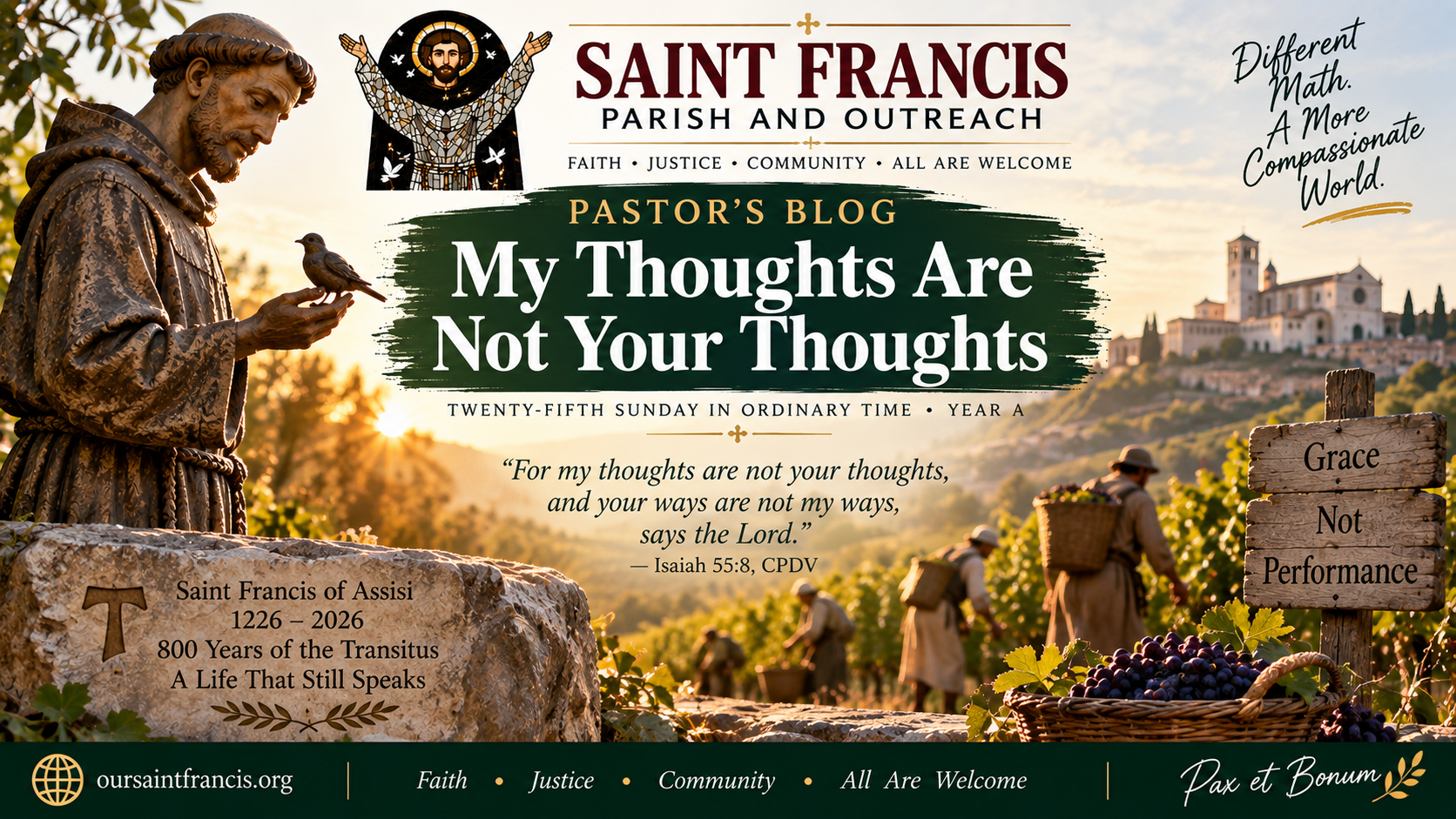
For my thoughts are not your thoughts, and your ways are not my ways, says the Lord. (Isaiah 55:8, CPDV)
A Different Kind of Math
Isaiah is not offering a vague comfort here. He is naming a specific, deliberate gap between how God measures things and how we measure things. And this Sunday's Gospel, the parable of the workers in the vineyard, puts that gap on full display: a landowner pays the worker hired at the eleventh hour the exact same wage as the one who worked since dawn, and when the early workers complain about unfairness, his answer is not an apology. It is a question. Is your eye evil because I am good?
I have spent a long time assuming that the measure of this parish's faithfulness is attendance, growth, the visible curve going up and to the right. I do not think that assumption survives an honest reading of this Sunday's texts. The landowner in that parable is not running the kind of economy where value is measured by hours logged or results delivered. He is running an economy of grace, and grace, by definition, does not obey the math the rest of us have been trained to trust.
I am not going to tell you that this fully resolves the hopelessness. It does not, not completely, not yet. But I am telling you that the specific thing the hopelessness keeps insisting on, that slow or small means failed, is not actually what these texts teach. My thoughts are not your thoughts. That includes, apparently, my thoughts about what counts as success.
Eight Hundred Years
I want to turn, now, to something that has genuinely given me joy this week, because I think joy is allowed to sit right next to honesty rather than waiting for the honesty to be resolved first.
On the evening of October 3, 1226, Francis of Assisi, this parish's patron, died at the Porziuncola outside Assisi, having asked to be laid on the bare earth as his final act of poverty. Because he died in the evening, it was already liturgically the next day, which is why his feast is kept on October 4 rather than the 3rd. Franciscans call this passing the Transitus, and this year, 2026, marks eight hundred years since it happened. The wider Catholic world is marking this anniversary with an entire Jubilee Year running from January 2026 into January 2027.
I want this parish to mark it too, in a way that means something concrete for you.
A Plenary Indulgence for October 4
As Bishop of this Diocese and Presiding Bishop of Old Catholic Churches International, I am announcing that anyone who attends Mass at Saint Francis Parish and Outreach on Sunday, October 4, 2026, the feast of our patron and the eight hundredth anniversary of his Transitus, will receive a plenary indulgence.
I know that language can sound distant or overly formal, so let me say plainly what it means: it is the fullest expression this tradition has for God's mercy meeting you completely, offered specifically because a man eight hundred years ago gave up everything he had and found, at the very end, that it was more than enough. If Francis's whole life was an argument that God's economy runs differently than ours, this feels like the right anniversary on which to extend that argument to you directly.
Come October 4. Bring whatever hopelessness or joy or both you are carrying. Let this be one more place where my thoughts are not your thoughts turns out to be genuinely good news rather than merely a hard teaching.
Thank you, as always, for staying with me through the honest weeks as well as the joyful ones.
Pax et Bonum,
Bishop Greer